Failure of the electric power system
Earth AbidesThe failure of the electric power system is the first visible collapse of a modern network that continues working after its human operators are gone. The generators and automatic connections keep electricity flowing for weeks, but a neglected maintenance task at the governors sets off a cumulative failure. For Ish, the final fading of the lights turns an invisible technical weakness into a scene of personal loss and a measure of how long the old world’s systems can endure without care.
A System Designed to Outlast Its Operators
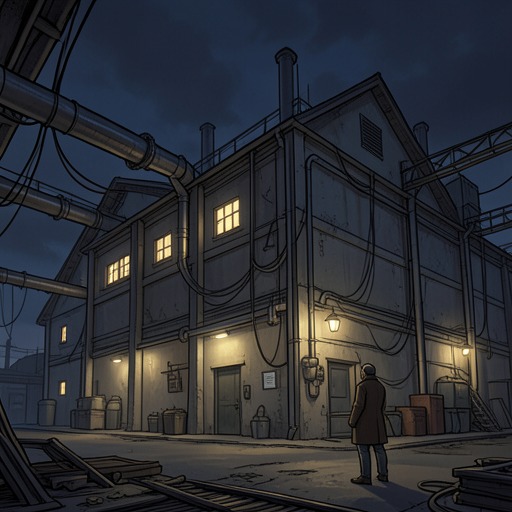
The Power-and-Light system does not fail when the disaster begins. Its generators continue sending precisely timed pulses through the wires even as people fall sick and the catastrophe reaches its end. The network has been carefully arranged to absorb ordinary breakdowns: if a wire fails and cuts a town off from the flow of power, the system adjusts before the wire even falls to the ground. If a power-house stops working, others spread across hundreds of miles quickly take up the load. Its apparent self-sufficiency is real, but only within limits.
That resilience shapes Ish’s first understanding of the disaster. When he comes down from the mountains, the water pouring from the power-house tailraces and the generators’ low, continuous hum reassure him that things must be normal. The familiar current still moves through the system, and its persistence makes it seem as if human absence has not yet reached into the machinery. In retrospect, that reassurance is also an irony: the equipment is still functioning, but the maintenance that sustains it has already stopped.
The Small Failure Behind the Network’s Decline
The weak point lies not in the great generators or the flow of water that turns them, but in the governors that control them. These regulators were not made wholly automatic. Someone had to inspect them for oil every ten days and, perhaps once a month, replenish their supplies. The duties were small and regular, easy to overlook precisely because the larger system was so carefully engineered around them.
After two months without attention, the oil runs low. The governors begin to fail one after another. When a governor stops working, the water nozzle changes angle automatically, allowing water to pass through without touching the wheel; the generator then ceases to revolve and produces no more power. The automatic response prevents a failed governor from leaving water against a stationary wheel, but it cannot restore the generator’s output. Each lost unit places more strain on those still operating, and the system’s decline becomes cumulative. Redundancy can redistribute a load; it cannot indefinitely replace maintenance.
The account presents the failure as a weakness built into the system’s design rather than as a sudden, spectacular break. The network can route around a broken wire or a disabled power-house, but its regular inspections and oil replenishment have no equivalent automatic substitute. A system able to correct many visible faults remains vulnerable to one ordinary task that requires a person to keep doing it.
Ish Watches the Lights Go Out
Ish falls asleep in his easy-chair after midnight, unwilling to go to bed while the lights may still burn for hours or even days. When he wakes, the lamps have faded to orange-red filaments, dim enough to look at without hurting his eyes. The room is already in half-darkness, though he has not turned off any of the lamps. The change makes the system’s decline perceptible not as an engineering report but as a weakening light in the room around him.
He thinks of the power system as having held up remarkably long, with its automatic processes still functioning though the people are gone. He remembers the generators’ hum and the reassurance he felt on his first return from the mountains. He also recognizes that these may be the last electric lights burning anywhere, and that once they fade the world will be without them for a long time. The thought lends the failure a scale beyond his own household: the lights are at once a local utility and the remaining sign of a technological world.
The lamps linger at cherry-red. Ish sits awake, wishing the end would come quickly and with dignity rather than being drawn out, and thinks that this is the end. For a moment the filaments seem to flare brighter; then they go out. Princess stirs and gives the half-bark of a dream. Ish steps outside, briefly considering whether a local line might have failed, but is sure that this is not the explanation. Smoke turns the moon orange, and he can see no light along the streets or anywhere on the bridge. The failure is no longer a problem that can be isolated to one broken wire: the darkness confirms the end of the system as he knew it.
Ish returns indoors, finds the drawer where his mother kept candles, and lights one. Its flame is weak but steady and continuing, a small replacement for the current that had seemed so dependable. He remains shaken. The contrast does not restore the lost network; it marks the difference between a fragile light sustained by a person in one room and the immense infrastructure that once illuminated the world.
Maintenance as a Wider Pattern
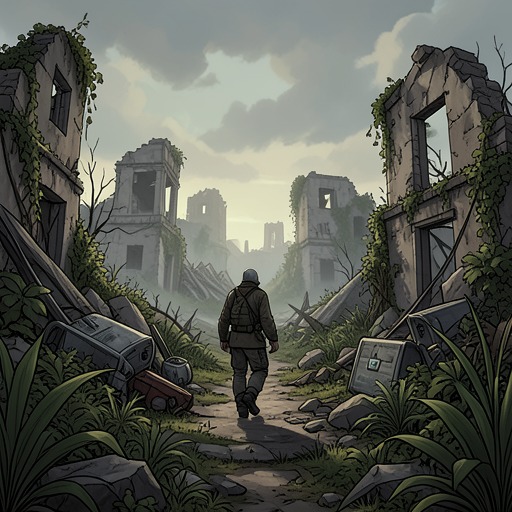
The power failure belongs to a larger pattern in the novel: infrastructure can persist after its builders, but unattended defects accumulate until familiar systems no longer work. On San Lupo Drive, a drain-pipe clogged by leaves sends water across the street, over the curb, through the overgrown Harts’ lawn and beneath their door. The runoff cuts a small gully through the rose-garden before entering a storm sewer. Ish recognizes that he could clear the drain in two minutes, yet sees no point in doing so when similar blockages must be occurring in thousands or millions of places. Roads, drains, and walls require continuous cleaning and repair; without that labor, weather exposes the countless small points on which they depend.
The aqueduct and reservoir provide another version of the same vulnerability. A steel pipe section had known imperfections and was accepted by an inspector whose judgment was dulled at the end of the day. A foreman later noticed a leak and had it patched, but after the disaster no one passed that way again. Elsewhere, heavy rain briefly slows the reservoir’s decline before the midwinter dry spell resumes it; water escapes through open faucets, leaking joints, and broken pipes until only a thin skin remains over the reservoir’s bottom. These failures are not the same mechanism as the governors’ loss of oil, but they share the crucial condition of an absent maintenance network.
The last lights therefore register more than the loss of electricity. Their long survival shows how much continuity machines can provide, while their gradual extinction reveals the limits of that continuity. The system does not fall because every part breaks at once; it fails because the work that joined its parts to human care can no longer be performed. What once looked automatic proves to have depended, all along, on people returning to inspect, replenish, clear, and repair.